
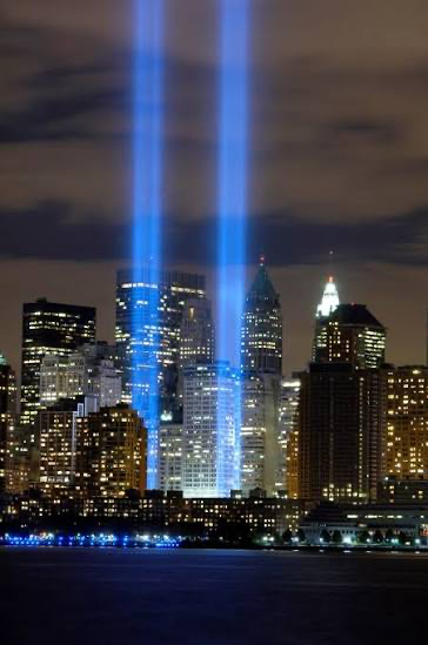
From online stock photo
Most of us over 30 remember exactly where we were on Sept 11, 2001 (except for one high ranking government official who sounds confused). I was spending my summer at the lake and writing a book with Aaron. As with most mornings that summer, I came down to the lake at dawn to meditate on the dock. It was a beautiful, soft and peaceful morning with a misty sunrise. I had just walked off the dock and was sitting at a picnic table journaling when a neighbor came running in, crying, “The World Trade Center has been destroyed…” There was no high-speed internet out there in those days. Another neighbor brought down an 8” black and white TV with grainy screen and we watched that video over and over. Then we three, and a few others, just sat in silence and prayer, filled with sadness.
It seems like we’re in the same place now: what to do about the hatred and destruction in the world. Please join me and so many world-wide today, knowing that love can and will prevail, however long it takes. In the words of that beautiful song: “We Shall Overcome” “Deep in my heart, I do believe, we shall overcome some day…”
Our son Davy Rothbart, a journalist, was sent to NYC on 9/12/01 on assignment by NPR radio and went to ground zero. He has written a beautiful essay about that experience, which is titled “New York New York”, in his book of essays “My Heart is an Idiot” (Farrar, Straus and Giroux, NY, 2012, available on Amazon) Below are a few paragraphs he shared with me today from that essay.
On September 12, 2001, I was sent from Chicago to New York City to do some radio reporting for NPR. For two weeks I roamed all over the city and interviewed dozens of people who shared emotional stories about the ways 9/11 event had affected them. It was a devastating yet deeply moving and meaningful reporting assignment.
Years later, for my book MY HEART IS AN IDIOT, I wrote an essay called “New York, New York” about my experience traveling to New York City during a time of massive upheaval and about the people I met and talked to during my time there in September 2001. Here are the last couple of pages of that essay:
The whole time I was in New York, I’d steered clear of the World Trade Center district—not because it was cordoned off and guarded by police and soldiers, but simply because it seemed too horrible to face in person, and I was afraid I’d only be in the way. My last night in town, though, at around two in the morning, I took my tape recorder and microphone, slipped past an unwatched barricade, and headed deep downtown on foot.
The streets were eerily calm, with no cars, no people, and no lights. I’d been in ghost towns out west, but the ghost city—where the only sounds were street signs creaking in the wind and rats pattering from one storm drain to the next—was chilling.
Past Canal Street, dark empty skyscrapers towered like the grand remnants of an ancient civilization. I knew I was getting close to where the Twin Towers had stood from the singeing, metallic odor in the air, and the thousands of loose-leaf papers carpeting the streets and sidewalks—paper, apparently, had somehow survived the fall of the towers, while iron, stone, and concrete had been turned to dust.
I came around the corner of Church Street and Chambers, and the sight took my breath away—four short blocks south, the remains of the World Trades smoldered in a massive, smoking, tangled heap, glowing orange and red, like the last embers of an eighteen-story campfire. This was what, at the time, people called “the Mound” or “the Pile,” and on all sides of it, hundreds of firemen scrambled around, shining zillion-watt spotlights, and aiming long, powerful hoses into the fray. The steaming wreckage was so mighty and oversized, it made the firefighters look like ants, their trucks and cranes like Lego toys. I sat on the hood of an abandoned taxicab layered in gray, powdery bits of rubble and took in the scene, in all its transfixing, surreal, and terrible splendor. This, I realized, as one hour hazily passed, and then another, was why I’d boarded the bus from Chicago—to be there and see things with my own eyes, and to try to understand.
It was a waking dream. Every once in a while, a dozen firemen, rescue workers, or soldiers emerged from the tableau and trooped past me, their faces dark and haunted, and another dozen clattered from behind me, toward the blazing Mound, pulling on helmets and buckling gear to their belts, ready to start a fresh shift. Giant flatbed haulers carried rubble away, past me up Church Street, one after another, each rig straining under the weight of a single sixty-foot iron girder. Tears stung my eyes. I felt invisible; I felt made of air; I felt consumed by grief and marvel.
At some point I pulled my headphones on, and with my microphone pointed straight ahead, I could make out the sounds of the firemen’s voices, shouting out to one another, maneuvering ladders and hoses and winches and ropes; I could even hear a sound I took to be the hiss and crackle of the dying blaze itself. Then, another sound flowed into my ears, but it was so faint and so odd that I took it at first to be my imagination—it was the sound of someone singing.
After a few minutes, I slid off my taxicab perch, and with the mic held out in front of me like a divining rod, I followed the strange, delirious voice, up Church Street, toward the action at Ground Zero. One block up, at Church and Warren, around the corner from a boarded-up pharmacy, two old men in tattered coats and lumpy knit hats stood scratching their backs on a street pole, facing the Mound. The shorter one stared straight ahead, while the taller one, with a salt-and-pepper beard, had his head tilted to the side and his eyes closed, having just finished a song.
I made a motion with my microphone to indicate my question to the shorter of the two: Would it be all right if I recorded this? He nodded and waved me closer. I stepped right next to them, at arm’s length, catching the hard scent of peppermint schnapps on their breath, mixed with the acrid burn of melted copper wire from smoke off the Mound.
The taller man smiled, eyes still closed but aware of my presence, and lifted his voice again in song. I closed my eyes to listen in, and felt immediately overcome with emotion, ripped with sadness, fear, and hope. I believed in that moment, and still do, that if me and those two guys could stand together on that four a.m. street corner and love one another, then there was still hope for our world.
This, then, is the most miraculous, piercing, and devastating two minutes of tape I’ve ever recorded—the song that old dude sang with great, half-drunken, gravelly abandon, his voice smoky, textured, and resonant as any legendary bluesman, while the junk trucks continued to grind past in the background, ratcheting from first to second gear, laden with debris. The song? I think it’s a Frank Sinatra song. It’s called “New York, New York.” I’m sure you know it.
—Davy Rothbart
Reading Davy’s experience, so beautiful, so traumatic, Barbara suggested I add my experience …
I went to New York when the bulletin boards were still up, and they had created a ‘museum’ where you could walk under a covering to get to the other side to the harbor and see the Statue of Liberty. They were still cleaning up. The buildings around the towers were scarred by the collapses, with pieces flapping in the wind. My friend took photos of the small piles of boots, clothing, and personal items left behind by people who had died. When we processed the photos and looked at them, the camera had picked up light streaming out from buildings and the piles of people’s personal belongings. One pile had a large beam of light emanating from these belongings; the buildings had light pouring out of where the scars were. It’s a mystery how the camera picked up the light. It was like the surprise of being gone so suddenly; their spirits were still lingering here.
You could feel the energy in the city, how people were traumatized. I saw New Yorkers clapping and shaking hands with the firemen, police, and emergency workers. I’m not a New Yorker, but I’m glad I got to experience this event and see the spirit in the light they offered in the photos.
— Tana Dean