
Sunset on the lake; the sky here reminds me there is always light and darkness, non-dual
Present day notes are at the end…with this exception.
Today would be my mother’s 109th birthday. She died 10 years ago, at age 98.
Thank you Mom, for teaching me about love, life, beauty and justice. So much that I share here came to me in childhood, in different words, from you.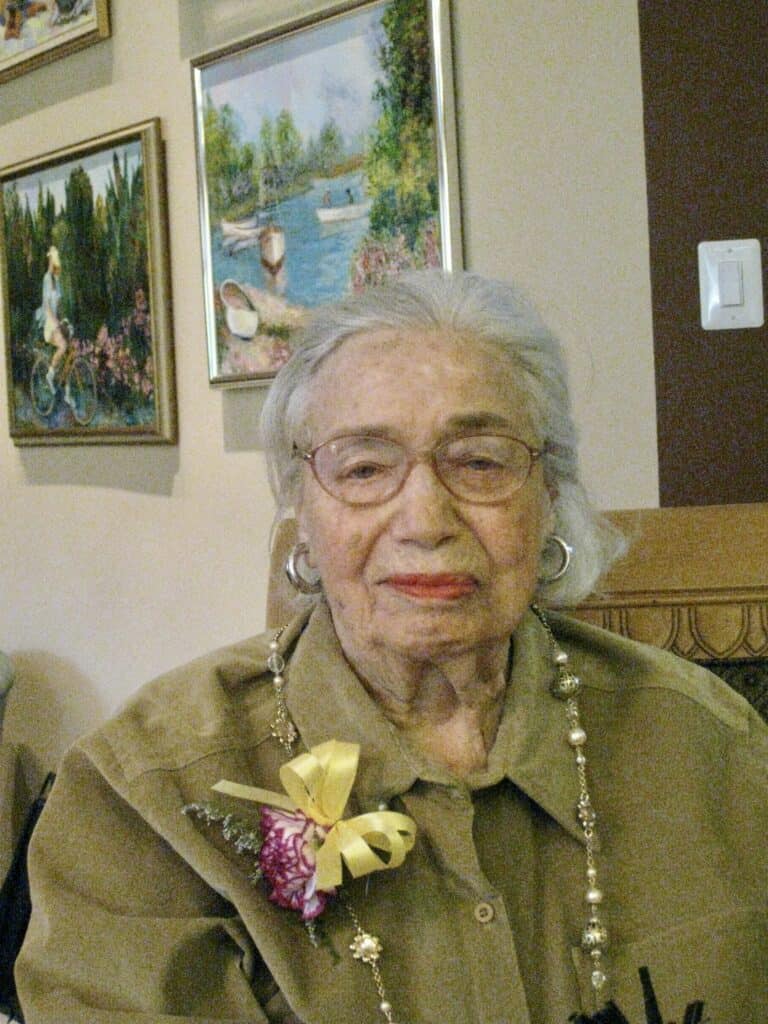
Ruth Brodsky at 95, with a few of her paintings in the background.
She continued to paint into her 90s.
Continuing from the book article, part 3: Each of us has had challenging experiences with our bodies. I have friends who have had cancer, strokes, ALS, migraine headaches, heart attacks, broken bones, and serious digestive issues. These bodies are impermanent. Each of us has had mental and emotional issues: grief, fear, and misunderstanding. And so many people in my classes and retreats have experienced anguishing feelings of unworthiness and abandonment.
So often the intention is to fix these issues of body or mind; to control them and make them go away. It’s understandable we don’t want this pain. But as the Buddha reminds us, within life there will be suffering or at least that which is unpleasant. For me these decades have been about learning to open to these experiences as teacher: not to hate them; not to try to fix anything; but to say, “thank you teacher,” and ask, right here with this blind eye, with this broken body, with the pain of loss, where is the ever-healed?
My practice of decades ago was a more linear practice than it is today. Mindfulness: first this, then that, then the next, watching it all arise and cease within the chain of dependent origination. Truly everything does arise out of conditions and ceases when the conditions cease. Such practice was vital to me at the beginning, to understand that what arose was not personal but simply the outplay of conditions. Yes, I had a part in those conditions but once the conditions were engaged, the results would just roll on until the conditions changed. My opening heart and deepening awareness are part of the change of conditions.
Gradually my practice shifted to include not only Vipassana, mindfulness, and lovingkindness but also the spaciousness of awareness, drawn from the Dzogchen and Pure Awareness traditions. Within these practices I could understand that the blind eye had risen out of conditions and also know that which can see was still there within me, even if not manifesting through the eye. In the same way in situations where there might have been great anger or fear, I came to know a deeper truth: that which is aware of fear is not afraid. That which is aware of anger is not angry. I am able to rest in that awareness yet with no denial of fear or anger.
Today Tuesday May 14 (actually written some days earlier…)
I’m slowly cutting away that downed tree with the help of one of Hal’s caregivers. It’s a huge job and there is no spare money to hire an outside person to do it. Besides, it’s irritating to have to hire someone to do something that I used to be able to do so easily.
Yesterday my new neighbor, whom I have met just once, since he bought his house to use as a rental, and doesn’t live there, complained to my husband’s caregiver (I wasn’t home) that the fallen tree was on his property, stopping him from mowing. “Get it off my property” he said with anger. But it is several feet my side of the property line.
Ahh, anger arose as I was told this story! What next? How does this apply to the meditation instructions above. First, Knowing anger as anger, not good or bad, wrong or right, just anger. Right there with anger as object, can I find the space?
Aaron’s frequent words: “that which is aware of anger is not angry.”
I spent some time down by the tree, just sitting, aware of anger; increasingly open also to that which is not angry… I hopeI can speak with him from that ground of compassionate awareness. I did cut one small branch that protruded onto his lawn.