
(book chapter part 9)
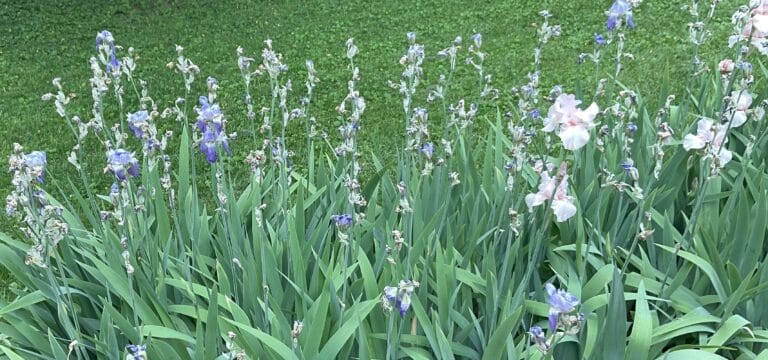
The inevitable fading of the giant iris
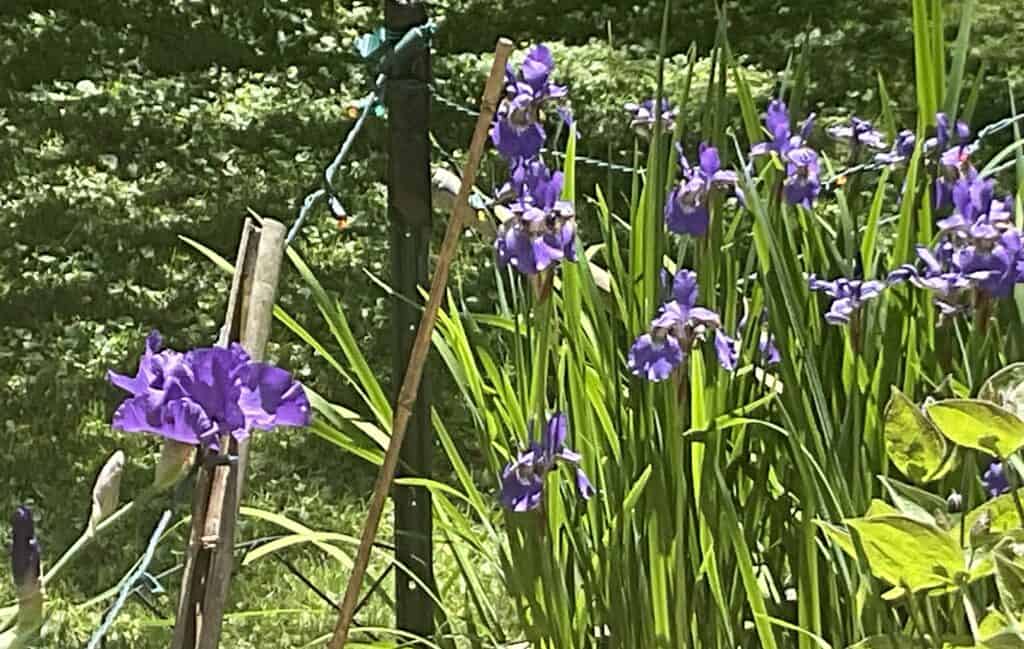
While elsewhere in the garden, the smaller deep purple iris are emerging – new life.
Notice the larger purple Iris on the left, reaching far over from the separate fading garden.
The past few years I’ve focused a lot of my attention on living my practice in a balanced way in daily life. Buddhist teaching gives us the 3 kayas or bodies: Dharmakaya, the Formless, ever perfect, or Divine essence. At the other end of the spectrum is Nirmanakaya, the expressions of the dharmakaya in the everyday world. This is our mundane realm. If you think of this as two shores of a river, mundane and supramundane, you’ll see an illusory duality. Imagine yourself walking down one slope, underwater on the riverbed, and up the other side. These two shores are not separate.
I kept returning to knowing fear as fear. What is the direct experience of fear, as separate from the stories fear presents? My vipassana practice was vital here. I had to stay with the experience, not move away into that enticing spaciousness: watching contraction in mind and body and acknowledging these. Fear showed up in a tense belly, in contracted shoulders, in mental agitation. For you it may show itself differently.
I call this practice the Path of Sacred Darkness. We’re conditioned to avoid the darkness or sometimes taught to go into the darkness as if to shatter and destroy it, trying to prove it is harmless. In doing so, we give it power. When darkness and light are known as non-dual, we can open gently to the darkness, which for me meant opening decades ago to a life of deafness; more recently, opening to a possibility of a life with an amputated foot, or a life without my husband, all with compassion for the human and with trust that somehow life will open into just what is needed.
From Julian of Norwich comes a beloved quote, “All shall be well, and all manner of thing shall be well.” To lose a foot is likely very unpleasant and painful. But it doesn’t mean it’s bad in any ultimate way. If it happens, it just is. My husband’s stroke was not bad in an ultimate way; unpleasant, challenging for us both, but also a great teacher. My deafness too. It has been the taskmaster and great blessing of this lifetime. On the relative or mundane level, a huge challenge. On the ultimate level, a profound teacher of compassion, leading me into spaciousness and a loving heart.
I turn to the Dharmakaya to know the deepest truth of being. I live much of my life in nirmanakaya, the mundane reality. How do I live balanced well between both? Imagine a bridge connecting the shores. There may be some people who can live mostly in the dharmakaya. Many people tend to lose themselves completely in the nirmanakaya with no memory that the dharmakaya exists. These are the people who struggle so with the catalysts of everyday life.
This bridge, as bridge or perhaps the river bottom connecting the shores, is the third Kaya. Sambhogakaya is sometimes translated as wealth body; that name and translation fit for me because it contains the combined wealth of the divine and of the mundane. How do I learn to balance on the bridge and where to balance? Sometimes after a deep meditation, I find myself dwelling deeply in the light, energy, and unconditional love of the dharmakaya. Then some painful catalyst pulls my attention, maybe body or mental pain, the pain of a loved one, the pain of the world, and I feel myself drawn back into being someone who wants to fix. I lose touch with dharmakaya.
When I am present, mindfulness notices this imbalance, often felt as subtle tension. Because of my intention to do no harm to myself or any other being, I come back into a more centered space. The center is not an absolute center but at times is closer to Dharmakaya, at times closer to the mundane realm. I practice the balance from a place of the open heart, born of intention to do no harm, a space of awareness and compassionate attention.
Writing today, May 31
Blog 10 book 9 extras
Finding the three kayas in reflections
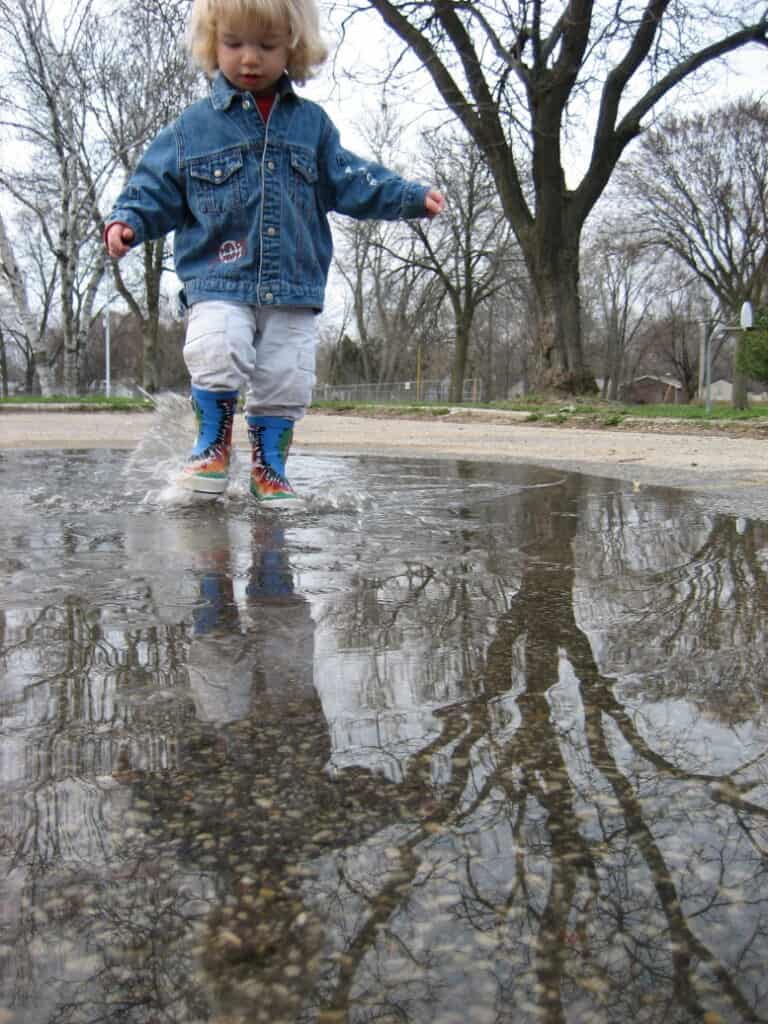
Grandson age 2 in 2008, in a puddle
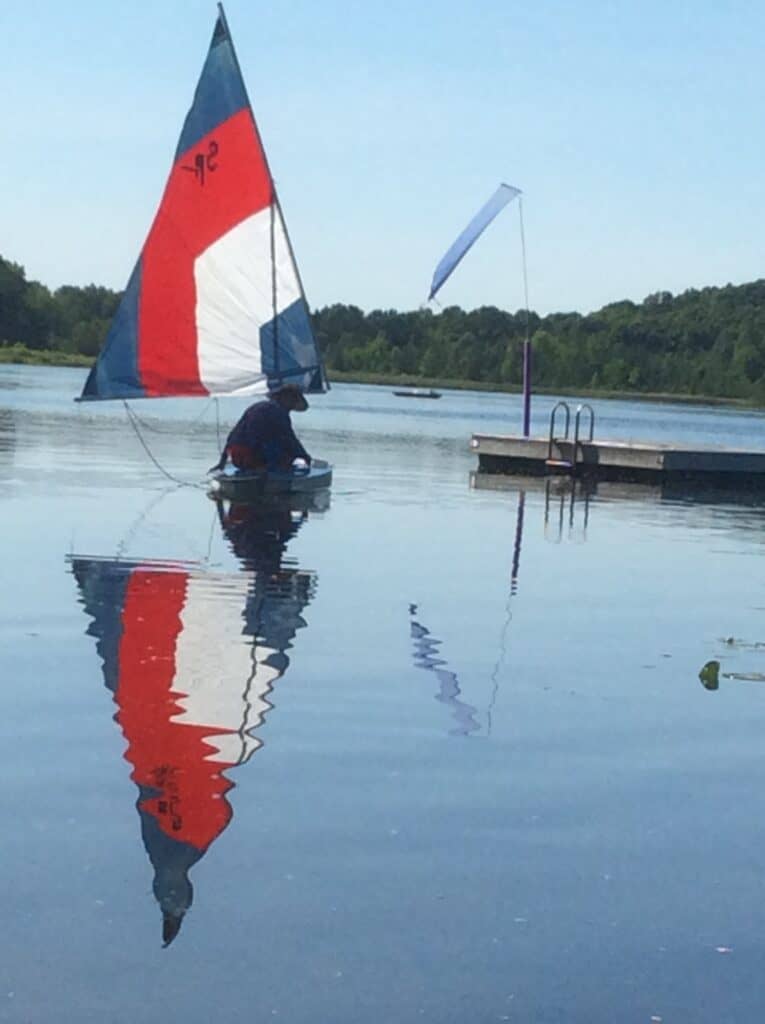
Hal sailing out from shore, around 2016
Looking at the photos above; which image is “real,” the solid body or the reflection? Both? That grandson is now in college; Hal can no longer sail. Our memories are images; what is the reality?
As I sat on my deck this morning with Hal, there was both joy and sadness. I was reading and he was watching a u tube musical on his iPad. About every 2 minutes he would pause, look up at me and, using his fingers, give me the sign “I love you”. His eyes were tender and smiling too. It was a beautiful morning; flowers blooming, birds at the feeder, a sweet breeze and I was clinging. There was deep sadness because I cannot hold on to such mornings. Is this to be our last summer together?
We know that everything changes in a moment; that we cannot hold on to anything. Where is the joy in this moment, this perfect moment in the middle of the river Dharmakaya is on one side, nirmanakaya on the other side, and I stand in the current. When I understand my capacity to hold the pain, the sorrow, not as my experience but that of all conditioned beings, and also to know the immensity of joy, of that glorious presence of pure being, of love, then I hold both not just for me but for all beings and know each being is doing that too.
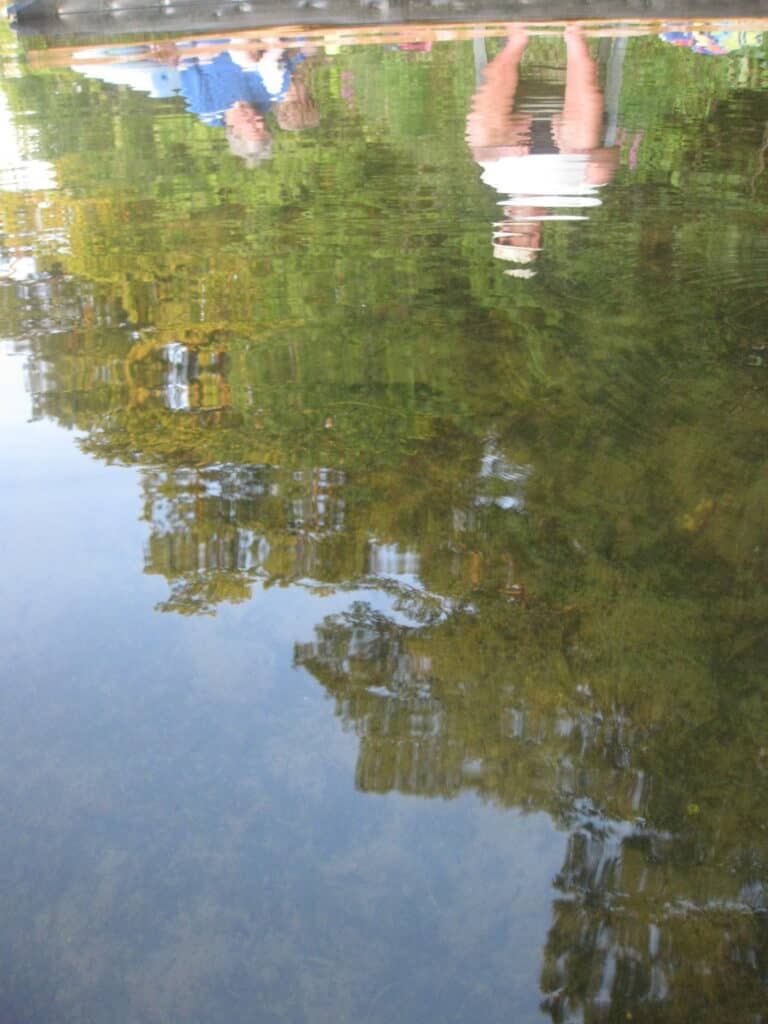
Hal, one of our grandchildren and I reflected, sitting on the lake raft.